
I am interested in the genetic mechanisms underlying biological diversification. I use a combination of genomics, transcriptomics, and diverse computational methods while maintaining a focus on ecological context and natural history. I primarily study wild relatives of crop species, along with crops themselves, to gain insight into both the domestication process and evolution in the wild. My research usually relates to one of the following themes:
Population genomics and biogeography
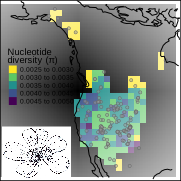
My research bends towards shallow evolutionary time scales and population-level questions: How is genetic diversity structured within species and across space? What is the genetic basis of local adaptation? Answers to these questions reveal how biodiversity is generated and maintained and can help us predict how species will respond to future environmental change. I have studied how gene regulatory evolution underlies wild sunflower adaptation to an extreme sand dune environment [Innes et al., 2024, Heredity], and illustrated the role of past glacial cycles and mountain ranges in shaping contemporary population genetic diversity of wild blue flax (Linum lewisii) across North America [Innes et al., 2025, bioRxiv]. My research on flax has also sparked an interest in mating system evolution, and the genetic basis and consequences of selfing versus self-incompatibility.
Genomic foundations for agriculture and conservation
Modern agriculture and conservation increasingly rely on molecular genetic information to accelerate breeding and manage threatened populations. Using genomic data, it is now possible to predict the performance of new crop varieties in novel environments and forecast evolutionary adaptation of wild populations to future climates. These efforts rely on robust genomic resources including reference genomes and population genetic surveys. My dissertation research on wild blue flax focused on building foundational knowledge and resources to support its neodomestication as a perennial oilseed crop [Innes et al., 2023, bioRxiv] [Innes et al., 2025, bioRxiv]. I have also studied genomic variation in the cannabinoid biosynthesis pathway of Cannabis sativa [Innes & Vergara, Botany, 2023], and more recently, in collaboration with colleagues at Montana State University and University of Wyoming, I led the assembly of the first chromosome-scale genome for Clark’s Nutcracker [Innes et al., 2025, bioRxiv], an iconic bird species of Western North America and mutualistic seed disperser of the endangered whitebark pine. In my current position in the Kane lab, I am working with the USDA Sunflower Research Improvement Unit to investigate the genomic basis of flowering time and phenotypic plasticity in cultivated sunflower.
Alternative splicing in plants
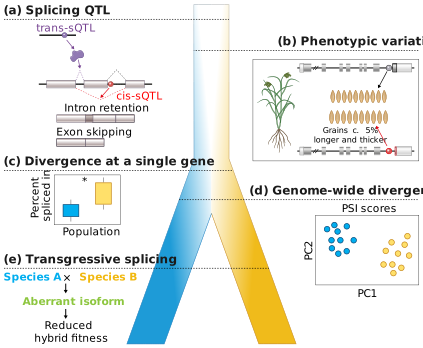
The process of RNA alternative splicing is key component of gene expression that creates multiple distinct transcripts from a single gene and thus increases transcriptome and proteome diversity. This regulatory mechanism is an important factor in human variation, health, and disease and also has key roles in plant development and stress response. I am interested in how alternative splicing variation contributes to plant evolution. I have shown that strong local adaptation in sand-dune endemic sunflowers involves divergence in alternative splicing, especially for genes within chromosomal inversions and with functions related to known adaptive traits [Innes et al., 2024, Heredity]. I also led a review paper synthesizing recent findings about the contribution of alternative splicing to plant diversity at time scales spanning the speciation continuum [Innes et al., 2025, New Phytologist].